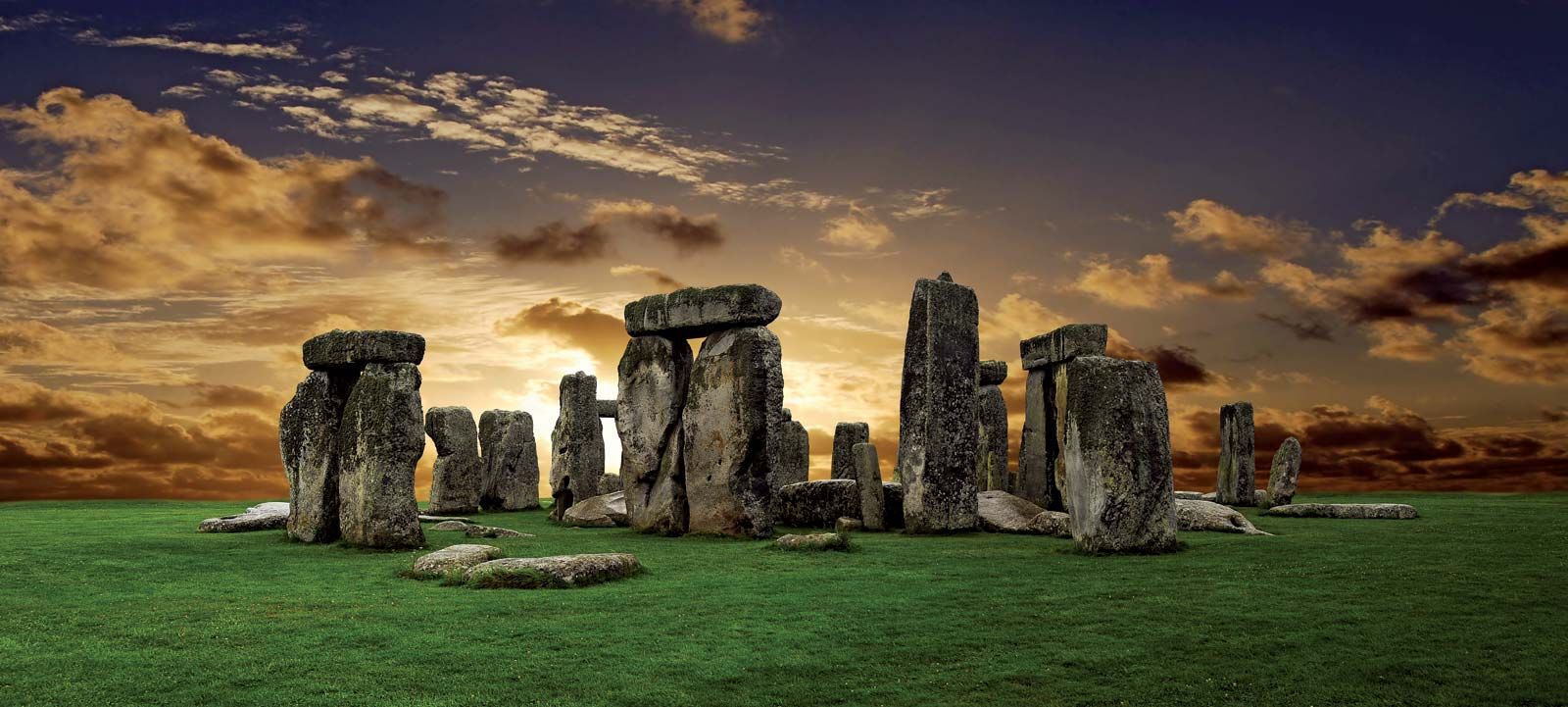
Stonehenge is a world-famous prehistoric monument located on the Salisbury Plain in Wiltshire, England, roughly two miles west of Amesbury. Constructed in multiple stages between 3000 BCE and 1520 BCE, it features a ring of massive standing stones that represents one of the most sophisticated engineering feats of the Neolithic and Bronze Age worlds. Together with Avebury, it is designated as a UNESCO World Heritage Site. [1, 2, 3, 4, 5, 6]
History & Construction
The monument was not built all at once, but rather evolved over a span of 1,500 years: [1, 2, 3]
- Earthwork Phase (c. 3000 BCE): It began as a simple circular bank and ditch enclosure dug using primitive deer antler tools. [1, 2]
- The Bluestones (c. 2600 BCE): Smaller “bluestones,” weighing around 4 tons each, were transported from the Preseli Hills in Wales—over 150 miles away. [1, 2]
- The Sarsens (c. 2500 BCE): The iconic outer circle was built using massive sarsen sandstone blocks weighing an average of 25 tons. These were moved from the Marlborough Downs about 19 miles away.[1, 2, 3, 4]
- Woodworking Joints: The stones are held together by precise interlocking mortise-and-tenon joints, a technique typically reserved for carpentry and unique among prehistoric stone circles.
Purpose & Mysteries
While its exact origin story remains mysterious, modern archaeological consensus points to a few central uses:
- Solar Calendar: The structure is perfectly aligned with the sun. It faces the sunrise during the summer solstice and the sunset during the winter solstice.
- Burial Site: Excavations show it functioned as one of the largest cremation cemeteries in Neolithic Britain.
- Ceremonial Hub: It served as a spiritual and ritual center for large-scale ancient celebrations and feasts. [1, 2, 3, 4, 5, 6, 7]
Visiting Stonehenge
The site is managed by English Heritage and is open to the public daily, except on Christmas Eve and Christmas Day. [1, 2]
- Tickets: Advanced booking for a timed entry slot is mandatory to guarantee access. [1]
- The Experience: General tickets allow you to walk the perimeter path around the circle. For a closer look, you can book a special early morning or evening Stone Circle Experience to step inside the inner ring. [1, 2, 3]
- Visitor Centre: Located a short shuttle ride from the stones, the center features an exhibition gallery, reconstructed Neolithic houses, a café, and a gift shop. [1, 2, 3, 4, 5]
If you are planning a trip or researching the area, let me know if you would like info on ticket prices, how to travel there from London, or other nearby prehistoric sites to visit.





-2.png)